
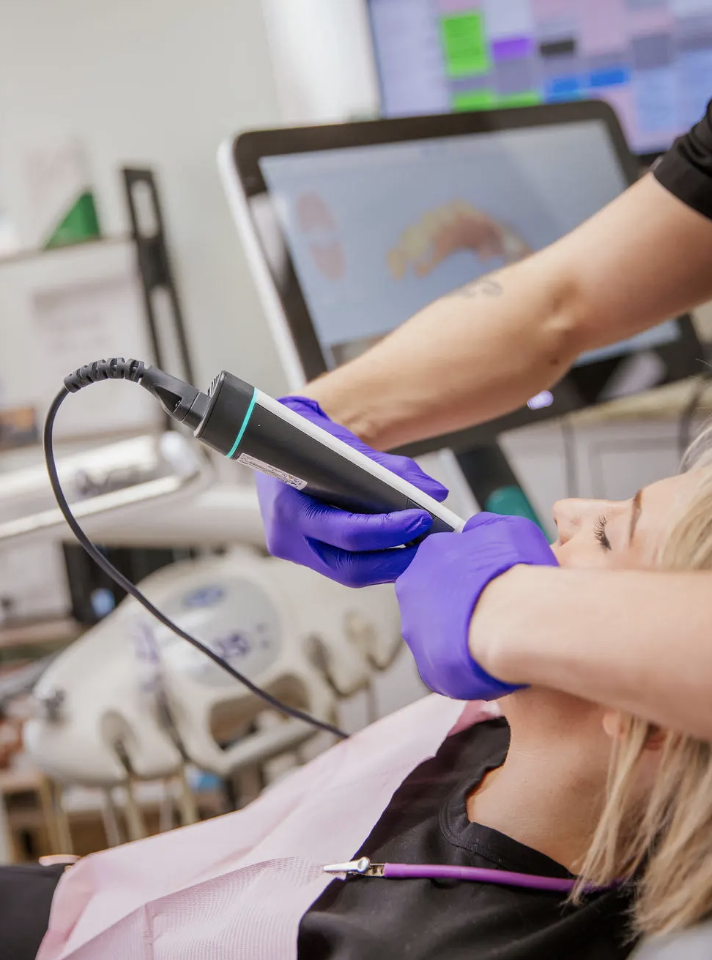
For most adults with crowding, gaps, or teeth that have drifted since high school, clear aligners can do the job without a mouth full of metal. Braces still win for some cases, mainly big bite corrections, badly rotated teeth, and patients who will not wear a tray most of the day. The right choice comes down to how your teeth need to move and how you live. We offer Invisalign clear aligners here in Tulsa, and this is the honest comparison we walk people through.
How each one moves teeth
Both apply steady, gentle pressure that slowly shifts teeth into place. The difference is what does the pushing.
Braces use brackets bonded to each tooth and a wire that gets adjusted at regular visits. They stay on for the whole treatment. You cannot take them off, which is part of why they work on stubborn cases.
Clear aligners are a series of thin plastic trays made from a digital scan of your mouth. Each tray is shaped a little closer to the finished result, and you switch to the next one on a set schedule, usually every week or two. Small tooth-colored bumps called attachments are often added to a few teeth so the trays can grip and steer them.
Clear Aligners vs. Braces: Key Differences
Visibility & Appearance: Clear aligners are nearly invisible up close, whereas braces rely on visible metal or ceramic brackets and wires.
Removability: Aligners can be removed for eating, drinking, brushing, and flossing. Braces are fixed to your teeth and stay on for the entire duration of treatment.
Daily Commitment: Aligners require discipline to wear 20 to 22 hours per day. With braces, there is nothing to remember to put back in.
Diet & Food Restrictions: With aligners, you take the trays out to eat anything you like. Braces require avoiding sticky, hard, or chewy foods that could damage brackets or wires.
Oral Hygiene: Aligners allow you to brush and floss normally. Flossing around braces requires extra tools and effort.
Office Visits: Aligner progress checks are generally fewer and shorter. Braces involve regular appointments for wire adjustments and tightening.
Best For: Aligners excel at treating crowding, spacing, and mild-to-moderate bite issues. Braces are best for complex bite alignment, severe crowding, and significant tooth rotation.
Where clear aligners shine
Aligners are a strong fit when:
Your front teeth are crowded or have gaps
Your teeth shifted after braces you had as a kid
You have a mild to moderate overbite, underbite, or crossbite
You speak in front of people for work and do not want brackets
You are disciplined enough to wear trays nearly all day
That last point matters more than any other. A tray sitting in its case does nothing. Patients who wear them as directed tend to finish on schedule. Patients who take them out for long lunches and forget them overnight tend not to.
When braces are the better call
Braces are still the stronger tool for severe crowding, teeth that are badly rotated, large jaw and bite corrections, and younger patients who will not keep trays in. If your scan shows a case like that, we will tell you so at the consultation and point you to an orthodontist we trust, rather than talk you into aligners that will not finish the job. If you are not sure which camp you are in, our post on when to see an orthodontist for crooked teeth covers the warning signs.
Not sure which one your teeth need? A scan settles it quickly. Ask us for a consultation and we will tell you plainly.
What about cost?
For similar cases, aligners and braces usually land in the same general range. What changes the price is how much your teeth need to move and how long that takes, not which option you pick. Dental insurance with orthodontic benefits often applies to either one, and HSA or FSA money can usually go toward treatment. We broke down the money side in how much Invisalign costs in Tulsa, and our insurance and payment page shows how we handle plans.
How long treatment takes
Simple aligner cases can wrap up in a few months. Moderate cases often run about a year. Braces cases vary just as much, and complex ones can go longer. Either way, you will need a retainer afterward, because teeth like to drift back to where they started. That is true no matter how they were straightened.
Why straightening often starts at a general and cosmetic dentist
Aligners are often one piece of a bigger smile plan. Maybe a chipped front tooth needs bonding, or you want whitening or veneers once things are straight. Straightening first gives every other step a better starting point, and it all happens under one roof with the same team. You can see the rest of what we do on our cosmetic dentistry page.
Frequently asked questions
Are clear aligners as effective as braces?
For crowding, spacing, and mild to moderate bite problems, yes, as long as you wear them as directed. For severe or complex cases, braces are usually more predictable.
Do clear aligners hurt?
You will feel pressure for a day or two with each new tray. Most people describe it as tight, not painful. There are no wires to poke your cheeks.
Can I eat with clear aligners in?
No. You take them out to eat or drink anything other than water, then brush and put them back in. That is also why there are no food rules.
Am I too old for clear aligners?
No. Healthy teeth can move at any age, as long as your gums and bone are in good shape.
Do you offer braces?
We focus on Invisalign. If your case is better suited to braces, we will tell you at your consultation and refer you to an orthodontist.
Find out which one your teeth need
A digital scan answers this question faster than any article. We look at how your teeth need to move, tell you whether aligners can get you there, and give you a timeline and a clear plan before you commit to anything. Our office is at 3747 E 11th St in Tulsa, a short drive from Broken Arrow, Owasso, and Bixby.
Request your aligner consultation or call or text us at (918) 834-2330.